Shipra Bhattacharya’s Five-Decade Artistic Journey
For nearly five decades, artist Shipra Bhattacharya has transformed observations of everyday life, women, society and the natural world into evocative paintings and sculptures. Her extensive artistic journey is now being presented in Chennai through Retrospective, an exhibition bringing together works created from her student years in the late 1970s to her most recent pieces.
Held at the Lalit Kala Akademi’s Regional Centre on Greams Road, the exhibition offers viewers an opportunity to follow the evolution of an artist whose work has continually responded to the world around her. The selection includes paintings, drawings and sculptures spanning different phases of her career, revealing how recurring themes have acquired new meanings over time.
Born in Kolkata in 1954, Bhattacharya studied at the Government College of Art & Craft and the College of Visual Arts after graduating from Calcutta University. Her early works were closely connected to her surroundings. Landscapes, fishermen, city life and human figures appear in works dating from the late 1970s and early 1980s, reflecting her interest in Kolkata and the social circumstances she witnessed there.
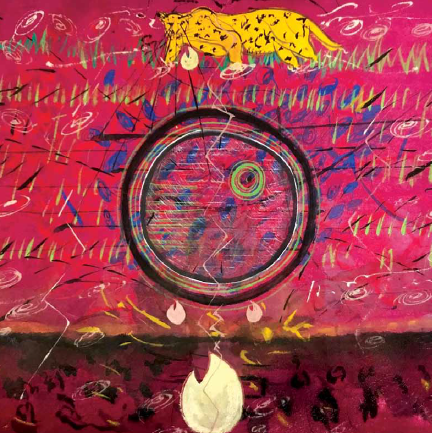
One of the most persistent ideas in her practice is desire. The theme appears in works made across several decades, from the 1980s through the 1990s and 2000s, and into her recent work. Its recurrence demonstrates how a familiar subject can continually change as an artist’s experiences and perspectives develop. Across different media, desire becomes connected with memory, relationships, imagination and the inner lives of women.
The female figure occupies a particularly important place in Bhattacharya’s visual language. Her women are often shown within domestic, urban or imagined environments, sometimes appearing contemplative and solitary. In later works, the human body can become almost a landscape, carrying symbols, creatures, plants and fragments of the outside world. The approach connects private experience with the larger world surrounding the individual.
Yet Bhattacharya does not want her paintings to be confined to one interpretation. For her, visual art can communicate things that words cannot fully express. Once a work leaves the artist’s studio, she believes viewers should be free to bring their own experiences and meanings to it. This openness is an important part of her artistic philosophy.
Her art has also responded directly to social and political upheaval. Taposhi, for example, emerged from the turbulent period surrounding the Singur movement in West Bengal. Other works, including War and Stop War, engage with violence and conflict. More recent paintings such as People and Floating continue this engagement with contemporary life, while her work has increasingly incorporated concerns about environmental destruction.
Bhattacharya’s artistic vocabulary has expanded beyond painting as well. Bronze and fibreglass sculptures now stand alongside her canvases and drawings. Works such as He I, She I, Flying Woman and Boat demonstrate her interest in giving physical form to ideas that once existed primarily on the painted surface. Since the pandemic, she has said that sculpture and the natural world have assumed a greater presence in her work.
The Chennai retrospective therefore becomes more than a chronological display. It is a record of changing perspectives: from the landscapes and social realities of Bhattacharya’s youth to questions of desire, womanhood, conflict, environmental anxiety and human vulnerability.
The exhibition also reflects the role of the Lalit Kala Akademi in presenting modern and contemporary Indian art through its regional centres. The Akademi describes its Chennai centre as one of several regional spaces dedicated to exhibitions, retrospectives, workshops and other visual-art activities.
After five decades of creating images, Bhattacharya continues to favour painting over explanation. Her approach can perhaps be summed up by her own question: if an idea could simply be written down, why would it need to be painted? Her retrospective in Chennai offers an answer in colour, form, figure and imagination—leaving viewers to discover their own meanings along the way.