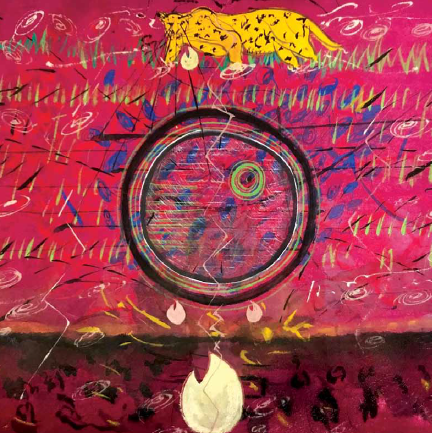
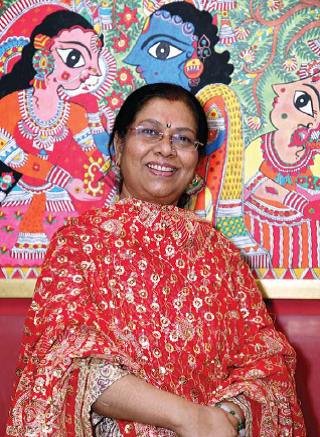
Kanchan Prakash, a contemporary folk artist, aims to revive this unique art form.
Kanchan Prakash is a contemporary folk artist whose practice is deeply rooted in the cultural traditions of the Bajjikanchal region of Bihar. Born in Muzaffarpur, Bihar and currently based in Delhi, she has dedicated her career to preserving and reinterpreting the rich visual heritage of her birthplace through a contemporary artistic language. Her artistic journey began in childhood, nurtured by the creative environment of Muzaffarpur and inspired by her parents, who introduced her to traditional folk art. A gifted student with a passion for painting from an early age, she received several awards during her school years for her artistic excellence.
Kanchan earned her Bachelor of Fine Arts (BFA) from Banaras Hindu University (BHU) between 1994 and 1998, followed by postgraduate studies at the National Institute of Fashion Technology (NIFT), New Delhi, from 1999 to 2001. Alongside her artistic practice, she has established herself as a freelance designer in the leather garments and goods industry, collaborating with several leading companies across the National Capital Region. Over the years, Kanchan Prakash has received numerous prestigious recognitions for her contribution to Indian art. She has been awarded the Senior Fellowship by the Centre for Cultural Resources and Training (CCRT), Ministry of Culture, Government of India, and the AIFACS Award. Her artworks are part of the collection of the Museum of Sacred Art, Belgium. She has exhibited extensively at renowned institutions including the Bihar Museum and the Lalit Kala Akademi, and has been allotted a studio at Garhi Studios by the Government of India. She is also a recipient of the Kumud Sharma Senior Contemporary Female Artist Award by the Government of Bihar, in addition to participating in numerous exhibitions across India.
The central focus of Kanchan’s artistic practice is the revival and promotion of Bajjika Art, a contemporary interpretation of the traditional visual culture of the Bajjikanchal region. Her works draw inspiration from village life, folk traditions, mythology, nature, feminine experiences and everyday rural narratives. Particularly significant are the influences of Banseri Bhitti Chitra—ritual wall paintings traditionally created on mud houses before marriage ceremonies—and Sujini embroidery, both of which were practised by the women of her family, especially her mother and grandmother.
Inspired by these indigenous traditions, Kanchan transformed the visual language of Banseri Bhitti Chitra and Sujini embroidery into paintings on canvas and paper, thereby creating a contemporary artistic identity for Bajjika Art. Through her efforts, she has worked with artisans across the Bajjikanchal region to revive this unique art form, enabling both women and men to preserve their cultural heritage while generating sustainable livelihoods through artistic practice. Bajjika Art is characterized by its vibrant colour palette, rounded human figures, decorative floral and geometric motifs, and the seamless integration of nature with human life. While deeply rooted in tradition, the art form also reflects contemporary social themes, creating a powerful visual narrative that bridges the past and the present.
For Kanchan Prakash, art is more than a profession—it is a lifelong commitment to cultural preservation, creative expression, and social engagement. Through her paintings, she continues to celebrate India’s diverse folk traditions while inspiring future generations to value and sustain their artistic heritage. Her work reflects a harmonious blend of tradition, innovation and a profound respect for the cultural legacy of rural India.